Unit Recommended Reading
Irvine, W and MacLennan, F (2005) Surveying for Construction, (5th Ed), McGrew Hill, Oxford
Books can be ordered from most bookshops or online from Amazon.
Studying
Before starting you should read the ‘Study Guide’ accessible from the link on the left.
Introduction
The unit is intended to introduce the learner to the setting out processes for buildings and structures and provide knowledge, understanding and practical ability in basic surveying procedures.
This learning package requires the learner to complete some of the unit content by practical means and exercises. The course includes the need to attend a two day practical group on the dates determined by the award providers.
Prior to attending the practical workshop the learner will complete the sections of this unit and obtain a pass in the e-learning aspects.
Please Note
All information contained in this Study Unit was considered correct at the time of writing but Students must not rely on information contained in the Study Unit and/or references for any purposes other than use within this CIOB qualification aim as legislation and working practices are constantly being revised and updated. Students are advised therefore to continually up-date themselves as to current legislation and construction practice and must not to rely on information contained within the Study Unit and/or references for practical applications in the workplace. Where legislation or construction practice has been superseded to that contained in the Study Unit Students should note this within their responses to the tasks.
Section 1 Obtaining Information
Learning outcome: On completion the learner will know how to obtain setting out information and check dimensional controls.
Contents
4.1.1 Identify the roles and responsibilities of the contracting parties for dimensional quality control.
4.1.2 Identify the sources of the relevant setting out information.
4.1.3 Obtain the relevant setting out information.
4.1.1 Identify the roles and responsibilities of the contracting parties for dimensional quality control
Setting out information is obtained from everyone who has been a part of the project from inception; this may initially be the client and their advisors who will have considered the size and form of construction needed and will undoubtedly have produced outline sketches of the building and its plan on site. All will have their ideas as to how the structure will fit onto the site and how much circulation and infrastructure land will be required. The final layout plans and details being produced by professionals working within the construction industry usually Architects and /or Engineers.
4.1.2 Identify the sources of the relevant setting out information
Plans will have been drawn up by the Engineer and Architect which position the structures on the site in an exact orientation and at an exact level. The position and level will have a direct relationship to fixed and immovable points on or around the site which can be re-established during the actual site setting out process.
The plans will have been submitted to the Local Authority and approval to construct granted before the setting out of the site commences.
The Site Manager will carry out checks on site and on the drawings and details to ensure that as far as is reasonable these are dimensionally accurate and the levels compatible with those of the final structure. Never scale from the layout drawings in order to determine dimensions. Setting out grids where provided by the Architect and /or Engineer are very useful in establishing setting out details but these are not always present.
It is the Architect and /or Engineer’s responsibility to ensure that all necessary setting out information is available; the setting out Engineer or Site Manager should not attempt to set out the building unless this information has been provided.
Many companies will use specialist setting out Engineers on large contracts. However a competent Site Manager should be capable of setting out all but the largest and most complex of buildings and must be able to carry out levelling and setting out subsequent to that of the Engineers.
This will be dealt with further in Section 4.3.1.
4.1.3 Obtain the relevant setting out information
The building setting out will be strictly in accordance with the details and drawings issued by the Architect and /or Engineer; any discrepancies between these drawing and documents should have been identified prior to commencement of the site setting out and clarified in writing by the Contractor. Any discrepancies identified at the site setting out stage should be referred to the Architect and /or Engineer for clarification.
The type of information needed will include:
- Operation boundaries
- Datum points
- Levels of existing buildings and other fixed objects
- Dimensions, location and levels of existing work area.
- Building line, frontage line and square line
- Lines and levels of the works
- Variations between specified and actual work dimensions.
- The personnel responsible for works.
The setting out should be approved by the Architect and /or Engineer before excavation commences and any approval should be obtained in writing for future reference.
Where a grid for setting out is not provided it is sound practice to establish a grid of levels to ensure that the amount of excavated materials is accurately recorded.
4.1.4 Identify permanent and temporary benchmarks and setting out points
Plans will have been drawn up by the Engineer and Architect which position the structures on the site in an exact orientation and at an exact level. The position and level will have a direct relationship to fixed and immovable points on or around the site which can be re-established during the actual site setting out process. These could be Ordinance Bench Marks (OBM), but are more likely to be local points established and documented on the contract drawings usually referred to as temporary bench marks (TBM).
4.1.5 Check the setting out points against the setting out information for the works
The required checking on setting out points will be a practical exercise during the two day field study.
 Task 4.1.1 Setting out Information
Explain the obligations on the site supervisor and how all relevant information is obtained to ensure that the setting out conforms to requirements.
Word Guide: 300 - 400
Section 2 Establishing Lines and Levels
Learning outcome: On completion the learner will know how to establish lines and levels for the works.
Contents
4.2.1 Relate the setting out information to the circumstances of the site.
4.2.2 Set out lines and levels for construction operations.
4.2.3 Determine the lengths of travellers for excavation and concreting.
4.2.1 Relate the setting out information to the circumstances of the site
This section will be considered in its entirety during the site field course.
4.2.2 Set out lines and levels for construction operations
This section will be covered in practical exercises during the two day practical section of the unit. Although it will be an advantage if you can understand the content and processes before you attend the workshop.
The equipment you will need to be able to use is:
- Tapes and rule
- Spirit levels and plumb bobs
- Optical surveying equipment.
The first two you will be familiar with one which may be new to you is optical surveying equipment and its use.
The following outlines the levelling process and the instruments that will be used during the workshop. It introduces you to the levelling exercise and how levels are booked and recorded.
Don’t worry too much if you are having problems understanding this, it will be explained to you on the workshop.
The Levelling Process
Optical Level
An automatic optical level is essentially a telescope which is used to sight on to a levelling staff. It must be set up so that it is level at all points when swung through 360º. It has controls to adjust focus, slowly traverse/clamp and to increase the definition of the crosshairs (black lines on eyepiece used to read the staff).
An example of an optical level is shown below.
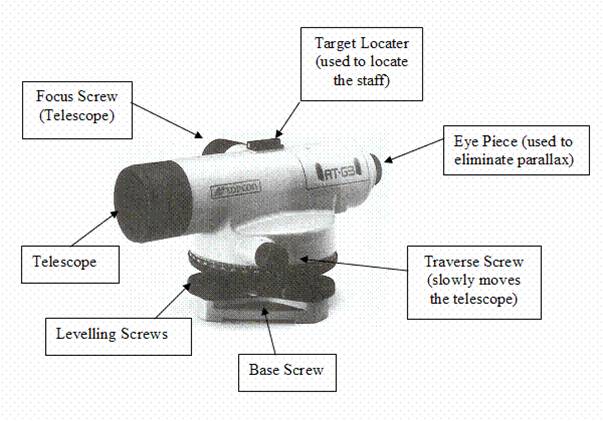
Figure 4.2.1 Optical Level
Setting up an Optical Level
Most modern tripods are made of alloy and may have straps tied around the legs for easy transportation. Setting up the tripod involves standing it upright, releasing the screws clamps on the legs and extending the top of the tripod to about the forehead level of the user. The screw clamps are tightened; the legs are spread and pushed firmly into the ground. Selected clamps may now be loosened to allow rough levelling of the top of the tripod and these are of course re-tightened prior to fixing the instrument. The tripod plate should be reasonably level at this point.
The level is attached to the tripod using a brass screw thread and handle, which is part of the tripod assembly. The screw housing on the base of the instrument ensures that the instrument is securely fixed, but should never be over tightened.
Key points in levelling the instrument ready for use:
- Level the instrument by adjusting the levelling screws.
- The bubble (not visible on the above image) should be central in the circle.
- Turn the telescope through 180º
- The level is accurate if the bubble remains in the centre of the circle.
- If the level is inaccurate the bubble will move outside the circle
- Parallax is the apparent movement of the cross-hairs over the levelling staff when the eye is moved up and down while sighting through the instrument.
- To eliminate parallax the eye piece should be perfectly focused on the cross-hairs and the Telescope should be perfectly focused on the levelling staff.
The procedure involved with these processes can be seen by watching the multi-media linked to in the left han column.
Levelling Staff
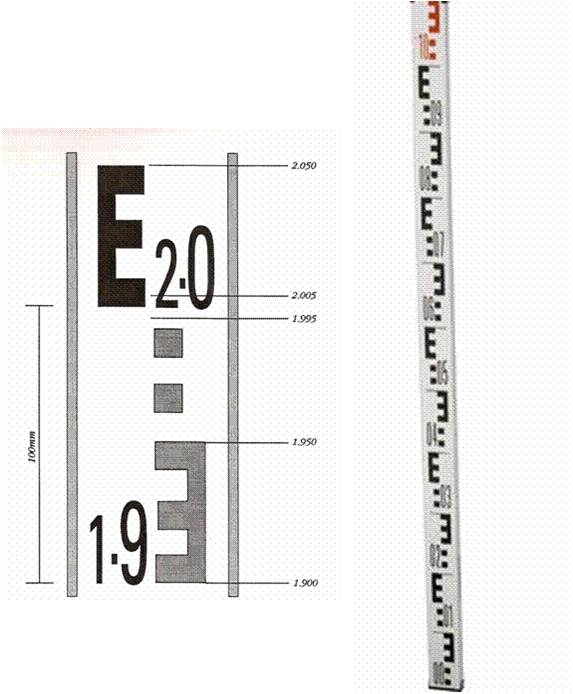
A levelling staff or rod is a graduated wooden or aluminium rod, which is graduated to allow the differences in elevation to be determined: An example is shown below.
Figure 4.2.2 The staff
Reading the Staff
A reading is taken through the lens of the instrument onto the rod and the reading of the level is recorded. This is done using the follow steps:
- Sight onto the levelling staff.
- Focus the telescope on the staff.
- Always ensure the bubble is central
- Take the reading of height.
- Each square is 1cm (10mm)
- First metre is black and second metre is red
- Each E is 100mm (0.1m) apart
Booking the Levels
The booking of the levels is done at the same time that a reading is taken. How this is done can be seen by watching the video ‘Recording Level Readings’ in the multimedia box below.
There are two methods of booking levels:
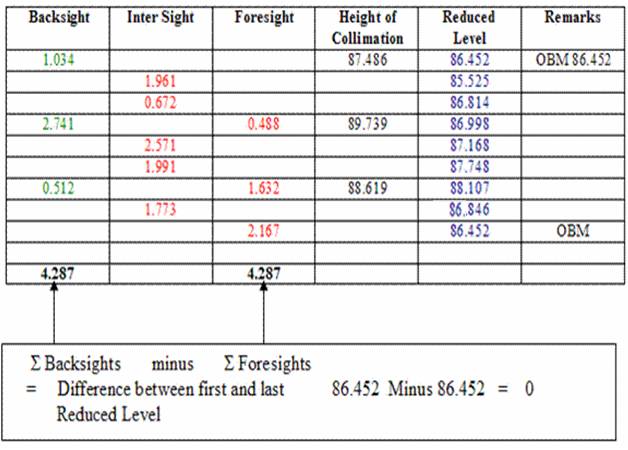
- Collimation Method: (The height of collimation is the height of the horizontal line of sight above the datum, and is sometimes called the height of instrument). In order to understand this you should watch the ‘Calculating the Height of Collimation’ video below.
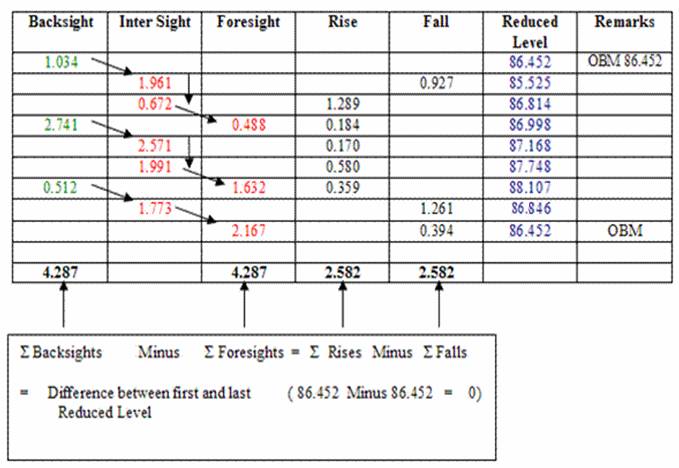
- Rise and Fall Method:
Advantages of the two methods of booking:
The advantage of the collimation method is that it is ideal for setting out reduced levels on site. The reduced level of points/pegs on site can easily and quickly be found by measuring down (or up, for inverted reduced levels) from the height of collimation.
The advantage of the rise and fall method is that it is the simplest method of booking and checking the calculations on site.
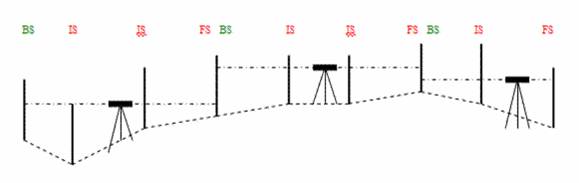
Figure 4.3.3 Taking measurements
Diagrams showing booking Procedure
This survey is booked as shown below. It starts and ends on the same OBM.
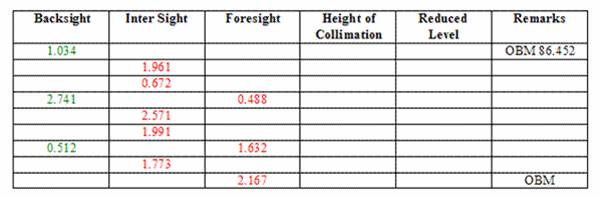
Figure 4.2.4 Booking sheet
Rules of Booking
- Back sight - the first reading from a new instrument position. The survey starts with a known level. This will be an Ordnance Bench Mark (OBM) or a Temporary Bench Mark (TBM). It is good practice to make the final reading for the complete survey to be at this point to check accuracy.
- The Back sight is added to the reduced level to give the height of collimation, entered on the same line.
- An Intermediate sight will occur between the Back sight and Foresight
- The Foresight is always the last reading from an instrument position
- The Foresight or intermediate sight is subtracted from the height of collimation to give the reduced level, entered on the same line as the foresight or intermediate sight.
- The height of collimation only changes when the instrument is moved to a new position.
- Every Back sight reading gives a new height of collimation, entered on the same line.
- All readings referring to the same point on the ground are entered on the same line.
The reducing of the levels using the above rules is shown in Figure 4.2.5
Figure 4.2.5 Height of Collimation calculations
Rise and Fall
Rules used when booking levels
- The first (and last) reduced level is on an Ordnance Bench Mark (OBM) or a Temporary Bench Mark (TBM)
- Following line by line down the page calculating the rise or fall between consecutive staff readings.
- A rise occurs if the first staff reading is greater than the second staff reading in any consecutive pair of staff readings.
- A fall occurs if the first staff reading is less than the second staff reading in any consecutive pair of staff readings.
- Add the rise or subtract the fall from the preceding reduced level to obtain the new reduced level, entered on the same line as the rise or fall.
Figure 4.2.6 Rise & Fall Calculations
To work through this process you should watch the video 'Calculating Rise and Fall' in the multimedia box.
Accuracy Issues
For all types of survey the accuracy of level values should be as follows:
- Site TBM relative to Ordnance Survey bench mark ± 10mm
- Spot levels relative to TBM within 10mm on hard surfaces 90% should be to ± 5mm.
If the closing error exceeds these values the survey should be repeated.
Checks on Calculations
Check on reduced levels obtained from back sights and foresights
Sum of back sights - sum of foresights = first reduced level - last reduced level.
Rise & Fall
Sum of back sights - sum of foresights = first reduced level - last reduced level = sum of rises - sum of falls = first reduced level - last reduced level.
Height of Collimation
The Height of Collimation is the height of the line of sight of the instrument over the station above which it is centred, such as the specified datum level or Ordinance Bench Mark (OBM) the way this is calculated is explained in the multimedia presentation entitled ‘Calculating Height of Collimation’ in the multimedia box below.
Task 4.2.1 Taking Readings
With the use of bullet points, explain the process used in taking readings on a site.
Word Guide: 300 - 400
4.2.3 Determine the lengths of travellers for excavation and concreting
Where it is intended that the sight rails produced will be used for excavation or construction purposes rather than the use of laser or optical levels the use of a traveller (sometimes referred to as a boning rod) will be required. Accuracy in establishing the length of the boning rod to the depth below the line of sight is essential and relatively easily achieved; (as illustrated below).
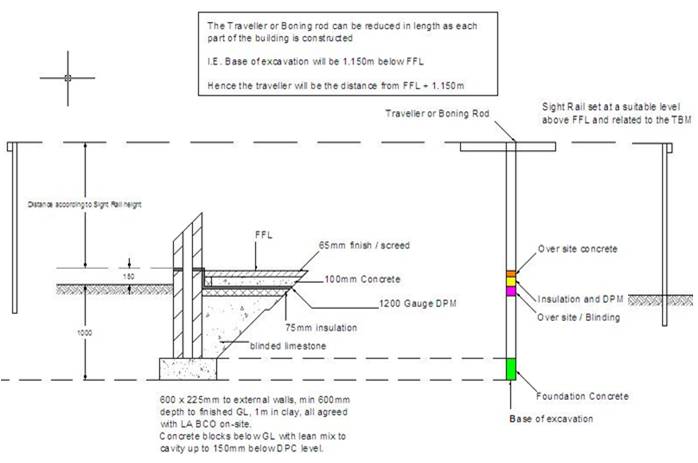
Figure 4.2.7 Travellers (Click Here to open in a separate window)
Where excavations will take place which are designed to facilitate sloping construction as in the case of drainage excavations, it is simply a matter of ensuring that the sight rails mirror the fall required and hence the excavation becomes shallower or deeper as the work progresses along the excavation by sighting through the sight rails and leaving the traveller unaltered in length.
The basic concept in the use of the boning rod or traveller is that by establishing fixed points at known levels it is a simple procedure to fix a third point by sighting through to others.
The traveller is always of a known length, and can be reduced in length as subsequent layers of construction are added.
Additional Information
If you would like additional information you can visit the constructionsite unit listed in the column on the left.
Task 4.2.2 Practical Exercise
This will be carried out during the attendance workshop
Section 3 Inaccurate or Missing Information
Learning outcome: On completion the learner will know how to deal with inaccurate or missing setting out information.
Contents
4.3.1 Check that the setting out information in the contract documents is mutually consistent and consistent with the site dimensions.
4.3.2 Inform any interested parties of any inaccurate or missing setting out information.
4.3.1 Check that the setting out information in the contract documents is mutually consistent and consistent with the site dimensions
Before the site can be set out you will need to ensure that you have all the relevant documents and information and that you have checked to ensure that is consistent and provides sufficient detail to allow the sit/building to be set out correctly. In order to do that you will need to check that:
- The drawings being used are the latest issue and are approved for setting out purposes.
- The drawings accuracy by adding the intermediate dimensions and ensuring the total is that of the overall dimension for that section of the structure.
- That the settings out points are clearly shown on the drawings and are related to fixed and immovable features on site.
- The distances between buildings can be determined and confirmed by site layout.
- If obstructions to the setting out process are present and determine how these will be overcome.
- That the Datum Point or Temporary Datum Point (usually referred to as a Temporary Bench Mark - TBM) given is easily located and accessible and that it can be transferred to site accurately.
- That the ‘Finished Floor Level’ and other datum reference are attainable.
- The accuracy of all equipment to be used in the setting out process, all instruments must be checked and calibrated where necessary.
- That the Setting out Engineer or Site Manager has the required information and recording documentation required.
- The settings out points are identified and dimensions triangulated to a fixed point on the building.
- The building line of the structure is documented and that further dimensions to establish other structure fixed points are present.
- Levels for the main features of the building are given or that they can be established from information present.
- Where appropriate levels for external works and drainage have been provided.
Task 4.3.1 Checking Information Details
Examine the drawings and details provided for this unit which can be seen by clicking on the links in the Drawings for Unit Tasks box above, and determine for the given site, information which is required in order that the setting out can be achieved accurately.
Word Guide: 300 - 400
4.3.2 Inform any interested parties of any inaccurate or missing setting out information
The information should be conveyed to the Architect / Engineer or others responsible for the provision of information by the use of e-mail, memorandum, letter or similar communication system; together with drawings details and illustrations of the required setting out information. You should also inform your line manager as the failure of the Architect/Engineer to provide the information can have an effect on the project.
Task 4.3.2 Communicating Information
Using the information obtained from Task 1, Communicate with the Engineer/Architect in the above formats requesting the required information.
Word Guide: 300 - 400
Task 4.3.3 Reflective Account on Unit
Produce a reflective account on what you have learnt in this unit and how it has been of use to you. You should consider what you have learnt; how you have put this into practice and the benefits it has brought to you and your organisation. You can state examples or incidences as a means of illustration.
This task will be completed after the workshop.
Word Guide - 800 - 1000
Unit Complete
You have now completed Unit 4, and you should complete the assignment and send it to info@gatesmacbain.co.uk.
When submitting your assignment you should ensure that it meets all the requirements set out on the Submitting Assignments page, which is accessible from the Student Area or towards the top of the column at the left of this page.
If it does not conform in all respects it will be returned to you and not sent for assessment resulting in delay. ALL questions must be answered in your own words. Any indication of plagiarism will mean that the assignment will fail and be returned to you.
You will be notified as soon as it has been assessed, which will then enable you to continue.